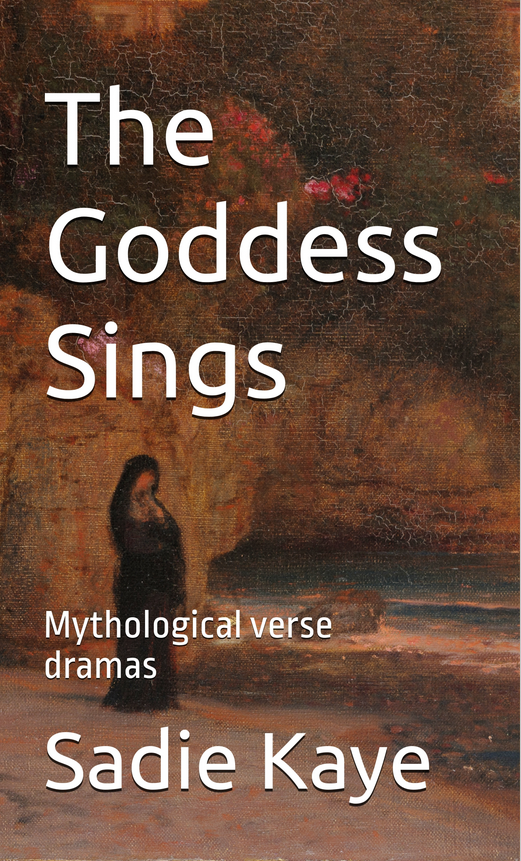
The Goddess Sings is a collection of nine mythological plays, monologues and dialogues which focus old light on modern life; its joys and injustices — in particular for women.
Here are nine tales of women: powerful women; considerate women; downtrodden women; misunderstood women; as well as women exercising their considerable free spirit. Some tales are comic, some are thoughtful, and some are tragic. All are researched from original sources and told in Sadie Kaye's beautiful verse with detailed introductions and references.
The descent and return of Inana
This is a retelling in verse of the Sumerian myth from Mesopotamia of when Inana, the Goddess of Love and War, descends to the underworld. It is told in Inana's own voice so that her considerable effrontery emerges slowly as the tale unwinds.
Dumuzid and Geshtinana
The sequel to Inana's Descent is poorly preserved in the clay tablets. Here is a possible reconstruction. Inana's husband Dumuzid is condemned to the underworld. He temporarily escapes only to be caught again. His sister, Geshtinana supports him and in the end they share their life in Hell, six months to each every year.
Lamia
Lamia is a North African who was briefly a lover of Zeus. She encounters Hera's wrath and is turned into a snake. Her unwarranted reputation as a cannibal and evil monster grows in ever greater fits of racism and transphobia all the way to the early 19th century and Keat's poem on her marriage. Here she speaks back and counters her accusers.
Rhiannon
Rhiannon is a Welsh horse deity from the Mabinogion. She chooses a mortal, Pwyll, but he foolishly offers her to his main competitor. Here is the comic story of how she uses her magic to turn this sorry state of affairs around, receives victimisation as an other-worlder in Pwyll's kingdom, and how their son, Pyderi, is mysteriously lost and then found again.
Travelling to the Sun
This is a Celtic story of the otherworld from Armorica (Brittany). A poor downtrodden farm girl chooses to marry a great prince like the sun, and her brothers attempt to visit her in her new home, the Crystal Palace. Nothing is as it seems and everything is strange.
The Lay of Estrild
Estrild is a beautiful Germanic princess who is traded as a commodity for her looks. She eventually has a daughter, Habren, and she and Habren come to a tragic end as part of the retribution of Queen Gwendolen. Habren is the river nymph that gives the river Severn its name.
The Swan
In Hans Christian Anderson's tale, did the Ugly Duckling realise she is a swan in time to live a happy life despite her downtrodden childhood, or did she come to terms with who she really was too late to enjoy her life as a swan?


Fenja and Menja
These are two giant sisters who are chosen for their strength, ignored because they are non-human and not good looking, and set to work. They are made to create prosperity without opportunities to rest or enjoy their work. So they change the magic and plot against the king who harasses them.
Derdriu
Derdriu (sometimes called `Deirdre of the sorrows') is from Irish mythology. But she is far from being a tragic being with no agency, nor is she any sort of femme fatale. She is skilled in magic and prophesy and manipulates the people round her to make the best of very difficult circumstances. In particular she finds true love, despite having been presented with an impossibly difficult life to navigate.